01
Parking data is isolated.
Licence-plate, ticketing and access systems sit outside the customer view.
Over the past twenty years, merchants have been able to significantly improve how their customer experiences acquiring goods, services and experiences. Shopping centres have struggled to keep up. Is it time to give up, catch up?
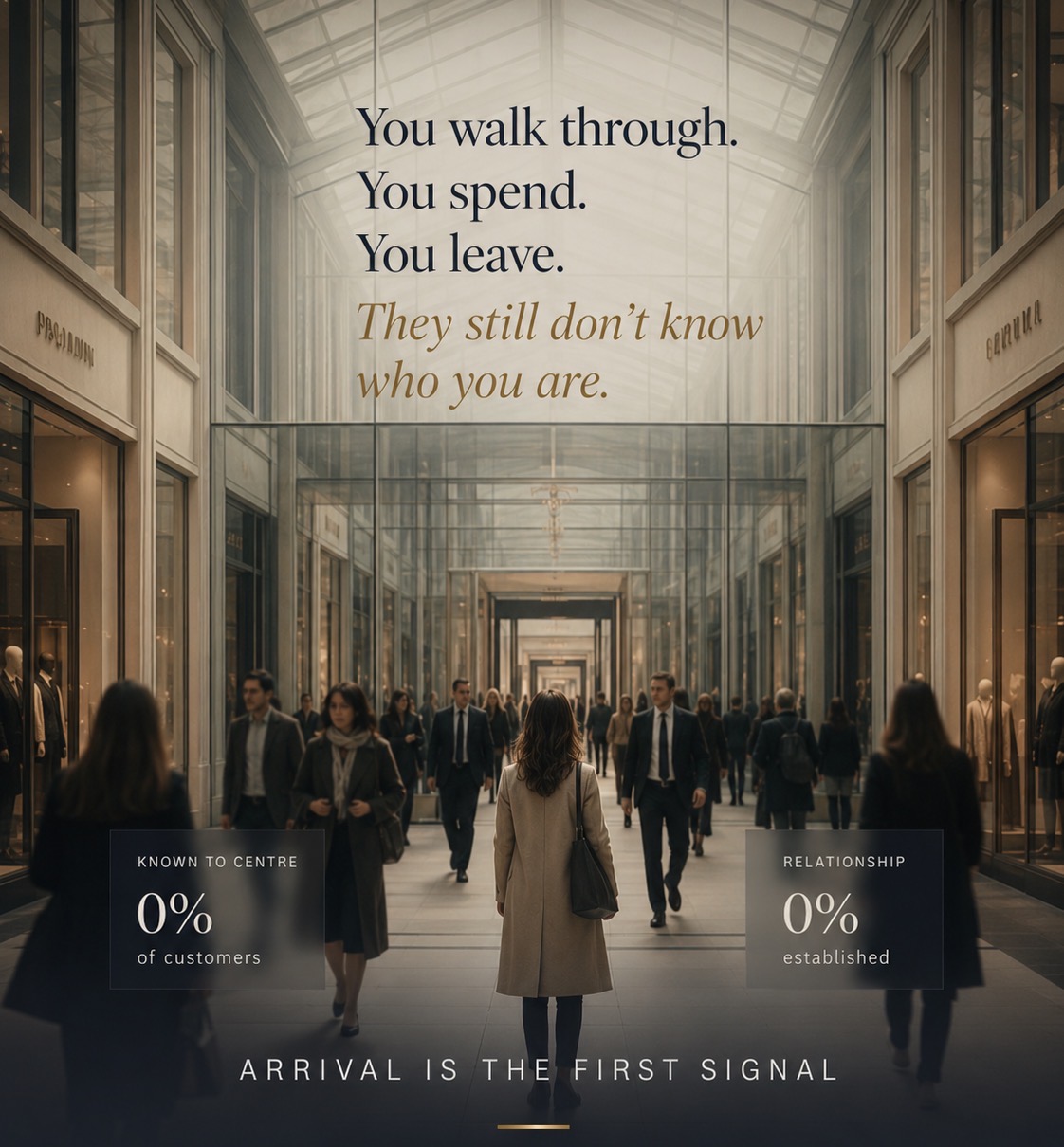
Organisations with transactional first-party data and a relentless focus on improving the customer experience are winning. Amazon, Coles, Woolworths, Apple, Meta and Google hold a structural advantage over businesses whose success depends on consumer choice yet who cannot reach the consumer directly.
Licence-plate, ticketing and access systems sit outside the customer view.
Built for eDMs, with limited segmentation, action triggers or commercial use.
Discount-led mechanics that fail to influence frequency, dwell or cross-shop.
Shopper experience is rarely designed, measured or iterated as a product.
Disconnected systems can't be reasoned over, so commercial intelligence is lost.
Disconnected systems reduce monetisation, relevance and shopper value.

The Landlord & Shopper Relationship
It has been hard for landlords to know the shopper. They don't transact, so there is no transactional margin to foster and fund a deeper interaction. Landlords facilitate the physical connection between shopper and tenant, and the perceived ROI on investing in physical tenancies has always been more predicable and preferred.
Landlords often view tenants as the core customer and are siloed around tenant and asset management. Without a shopper engagement strategy beyond the marketing remit, an effective solution is impossible to design and execute.
The customer window is opening
Shoppers are better understood and catered to, so expect more. First-party data has become easier to commercialise. Tech is cheaper and faster to deploy. AI has delivered a quantum leap in data utilisation, analytics and query.
You've been visiting every week for twenty years. You park here, shop here, eat here and spend thousands of dollars here... but I don't even know your name.
That's because you've never given me a reason to tell you.
Welcome. Enjoy our 200+ retailers, great parking, dining, entertainment and everything we have to offer.
😴
Your customers spend most of their money somewhere else — often on the very products and services you already offer.
Old model
New model
Shoppers have growing relationships with 1st Party Data Owners. Shopping centres' 1st Party relevance is declining and they are becoming increasingly reliant on 3rd Parties to reach their shopper.
3rd Party Data Renters
Want the shopper — blocked by the Owners
1st Party Data Owners
The gatekeepers
Shopping centres are increasingly having to pay for access and data on their shoppers as their 1st party platforms decline in relevance.
3rd Party Data
1st Party Data
The uncertainty on Marketing ROI and what's the right amount to invest continues to rise
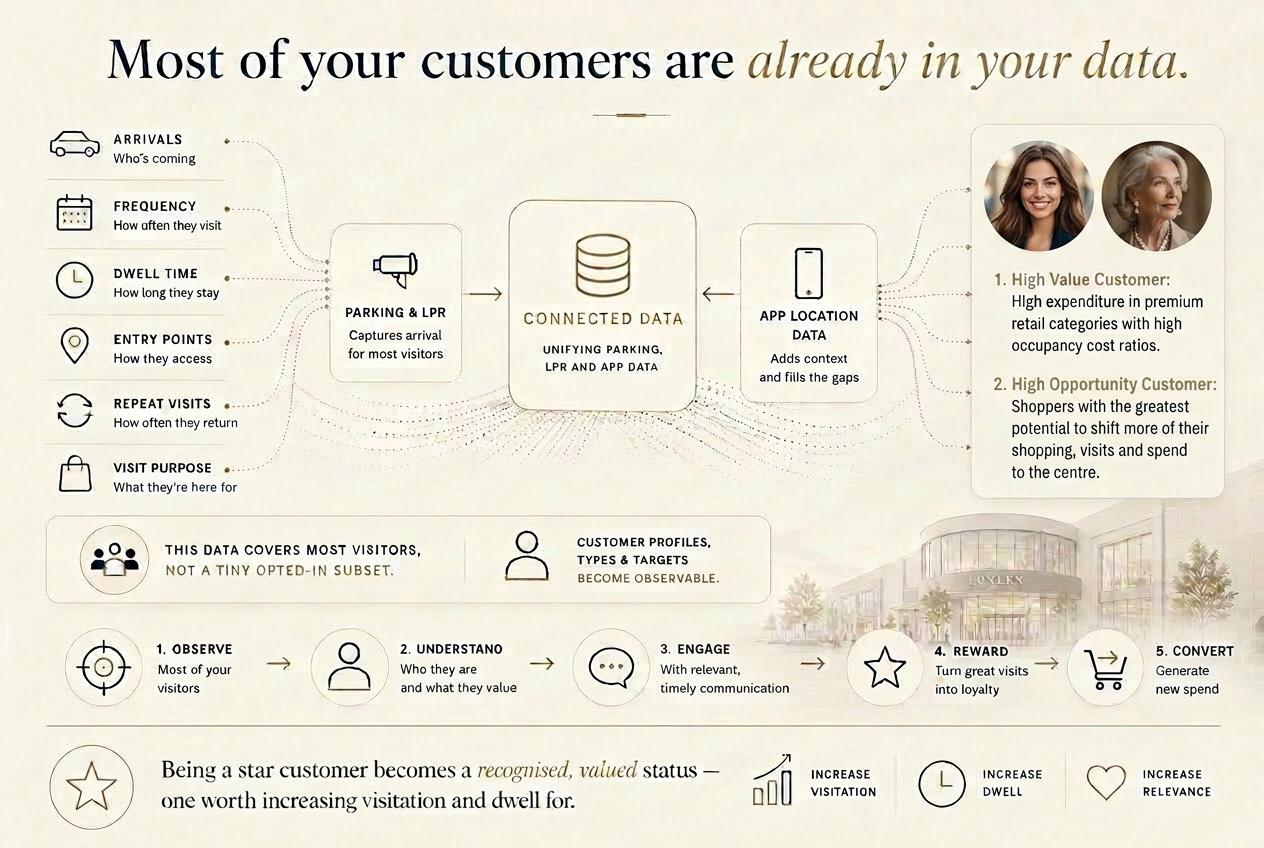
Parking and LPR systems are high-value signal sources: arrival, frequency, dwell, entry point, repeat visitation and inferred visit purpose. App location data can be used to augment LPR data to let everyone play. Many centres already capture this — it simply isn't connected to anything commercial.
This data covers most visitors, not a tiny opted-in subset. Customer profiles, types and targets become observable. Powerful, relevant and highly targeted communication becomes possible.
Being a star customer becomes a recognised, valued status — one worth increasing visitation and dwell for.
Strategic Insight
Unlike retailers, shopping centres have never had a direct transactional relationship with their customers. Without transaction data—or transaction margin (other than parking)—traditional loyalty and rewards programs have struggled to deliver meaningful value.
A Fundamental Shift
For the first time, technologies such as licence plate recognition (LPR), low-friction digital customer journeys, rich first-party data platforms and AI make it possible to design loyalty programs that meet these requirements.
What was previously impractical is now commercially achievable.
Ten Requirements for Success
Be effortless to join.
Require no conscious effort to earn rewards.
Can not be points or spend based.
Be powered by rich first-party customer data.
Deliver measurable value to both the shopper and the landlord.
Appeal to the broadest possible customer base.
Build awareness and aspiration, even among non-members.
Avoid creating a growing rewards liability.
Be simple and cost-effective to operate.
Generate a return many times greater than the cost of the rewards provided.
The objective is not to optimise assets, systems or operations. The objective is to deepen customer engagement and capture a greater share of customer spending.
Primary
The mechanism for understanding where customer spending goes and aligning every other strategy to win more of it back.
Key question
"How does this increase customer engagement and capture more of the customer's total spend?"
Most centres optimise individual functions. The highest-performing centres align every function around a single objective: increasing customer engagement and growing share of wallet.
Move from paying for expensive, ineffective third-party data to owning and operating highly valuable first-party data.
The goal is not only making shoppers spend more in a single visit. It is influencing frequency, dwell, cross-shopping, service usage, partner value and centre preference.
Headless, API-friendly and CRM-agnostic. The intelligence layer integrates with existing apps, websites, parking systems, CRMs and campaign tools — without forcing replatform.
Module
Acquisition and campaign participation.
Module
Onsite claims, benefits and rewards.
Module
Proof of participation and shopper-created moments.
Module
Deployment into existing websites, apps and microsites.
Map current systems, data sources, revenue streams and friction points.
Commercial opportunity, customer journeys, privacy constraints and pilot use cases.
One centre, one audience segment, one high-value engagement model.
Expand into multiple centres, retailer programs and revenue streams.
A focused engagement to surface the highest-value pilot for your centre or portfolio.
Engagements typically begin with a confidential diagnostic of your portfolio's data, parking and shopper engagement posture — followed by a pragmatic, sequenced plan.